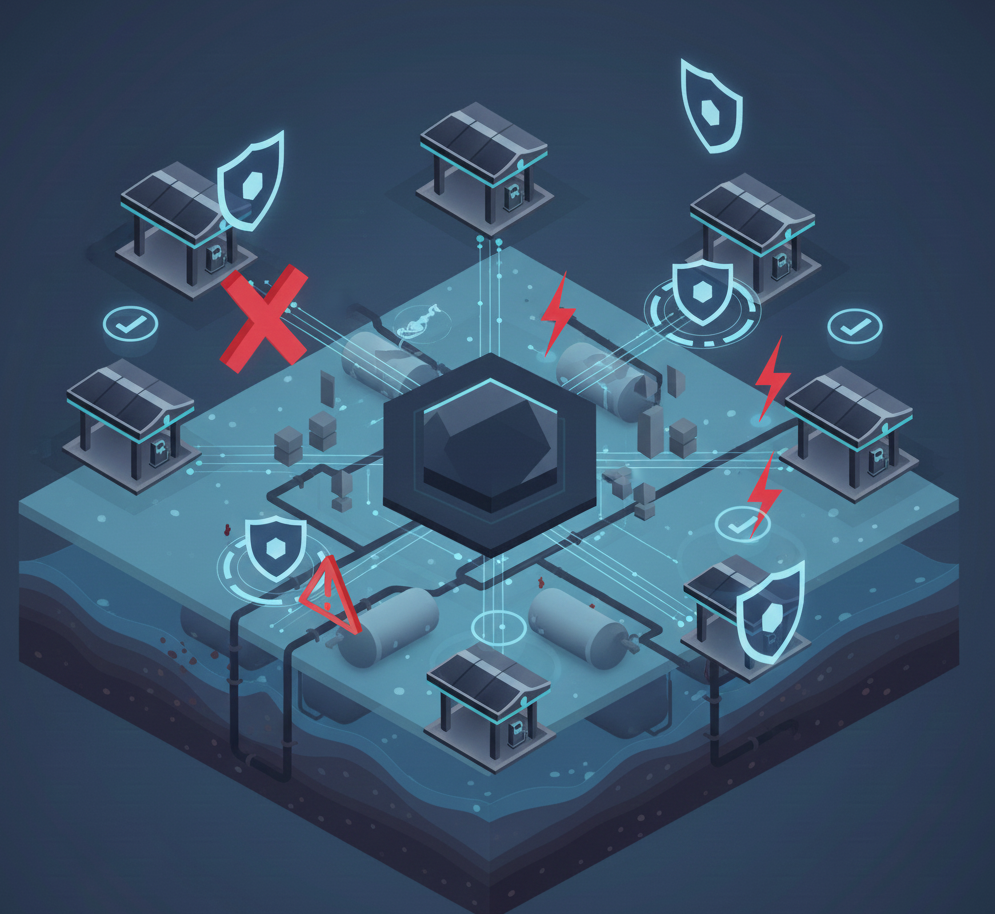



Unmanned fuel site compliance is often discussed as a technology problem: cameras, sensors, automatic tank gauges, remote connectivity and alarm systems.
Those technologies can improve visibility. They do not, by themselves, create governance.
Removing the permanent attendant changes how a service station is operated, but it does not remove the operational, environmental or compliance responsibilities associated with the site. For an enterprise fuel network, the more important question is therefore not simply whether a site can operate without staff.
It is whether the organisation can govern what happens when something requires attention, and later demonstrate exactly how that event was handled.
That requires a compliance system of record.
A compliance system of record is the authoritative environment in which obligations, decisions, actions, communications, evidence and closure status are preserved as one traceable operational history.
For unattended fuel operations, that distinction becomes critical.
The governance gap begins after detection
Modern fuel sites can already generate substantial operational information.
Automatic tank gauges can report tank conditions. Wet-stock systems can identify unusual variance. Cameras can provide visual context. Environmental and equipment sensors can identify exceptions. Payment, communications and site systems can report faults or loss of connectivity.
The difficult question begins after the signal is received.
An alert does not establish:
Context -> Priority -> Authority -> Response -> Evidence -> Closure
Someone, or a governed operating process, still needs to determine what the event means, whether intervention is required, who is authorised to act, what procedure applies and what evidence must be retained.
For an individual location, some of those decisions may be handled through phone calls, emails and experienced personnel who know the site.
That model becomes increasingly fragile across 100, 500 or 1,000 locations.
Different sites may interpret similar events differently. Decisions can occur outside the compliance record. Supporting evidence may be distributed across CCTV platforms, emails, external systems and spreadsheets. Head office may know that an event occurred without being able to reconstruct the full control response.
The problem is not necessarily a lack of activity.
It is a lack of governed evidence.

Petroleum regulatory frameworks connect monitoring, procedures and records
This distinction is particularly important in petroleum operations because regulatory frameworks frequently connect monitoring, procedures, incident management and record keeping.
The NSW regulatory framework for underground petroleum storage systems provides a useful example. Fuel System Operation Plan requirements include elements such as loss monitoring, incident management procedures, maintenance information, responsible-person details and site-specific system information.
The framework also contains requirements relating to incident logs, records of actions taken following detected discrepancies, and retention of specified documents.
Requirements differ across jurisdictions, but the governance principle is broader:
Detecting an exception is not the same as demonstrating that the exception was properly managed.
For a multi-jurisdiction petroleum network, that creates an infrastructure requirement.
Operational events need to remain connected to the relevant site, asset, procedure, obligation, responsible role, corrective action and supporting evidence.
Otherwise, an effective response at the time can still become difficult to defend months or years later.
From monitoring to an Event-to-Evidence Control Architecture
For enterprise fuel networks, unattended operations can be viewed through an Event-to-Evidence Control Architecture.
The control chain is:
Event -> Triage -> Verification -> Authority -> Action -> Evidence -> Closure -> Oversight
Each stage performs a different governance function.
1. Event
A connected system identifies a condition requiring attention.
This may originate from wet-stock reconciliation, an automatic tank gauge, CCTV, environmental monitoring, equipment telemetry, payment infrastructure or another operational system.
2. Triage and verification
The event is assessed to determine whether it represents a genuine exception and what additional context is required.
Technology provides visibility. Human judgement remains important where interpretation is required.
3. Authority
The enterprise determines what action is permitted, by whom, and under which approved procedure.
High-consequence actions should not depend on improvised decision-making.
4. Action
The approved operational response is initiated.
Depending on the event, this may involve escalation, stakeholder notification, initiation of an approved emergency response procedure, equipment isolation or another pre-defined response.
5. Evidence and closure
The organisation records what occurred, who acted, what procedure was followed, what supporting evidence exists and whether the issue was resolved.
This is the point at which operational response becomes compliance evidence.
6. Enterprise oversight
The completed event becomes part of the network's wider compliance history, allowing Compliance, Operations, Risk, HSE and executive teams to identify patterns across sites, assets and jurisdictions.
This final layer is what separates event management from enterprise governance.
The operating layer and the system of record perform different roles
A managed operations layer can address the immediate operational challenge.
This is the role Site Accord is designed to perform for unattended fuel locations.
Connected systems provide the signals. Operators triage and verify exceptions. Approved procedures establish how different events should be prioritised and handled.
A typical operational sequence may be:
Triage -> Verify -> Prioritise -> Act -> Evidence and Close
But the monitoring or operating environment should not become another isolated repository of operational history.
The resulting event may relate to:
- a specific service station;
- a tank or dispenser;
- a wet-stock exception;
- an environmental control;
- a previous defect;
- an inspection;
- an approved operating procedure;
- a compliance obligation;
- a corrective action;
- a communication;
- supporting documents; or
- a later internal or regulatory review.
Those relationships belong in the enterprise compliance record.
This is where Vertex Pulse performs a different function.
Site Accord manages the operational response. Vertex Pulse preserves the governed compliance record.
Why continuity of evidence matters
Consider a wet-stock exception at an unattended site.
A tank system or reconciliation process identifies an unusual condition.
The event is reviewed and prioritised. The approved response is initiated.
Further investigation or corrective action may then be undertaken by the relevant responsible party.
Operationally, the immediate event may then be closed.
From a compliance perspective, however, the event may still matter.
Within the Vertex Pulse architecture:
FuelSync
FuelSync can retain the relevant wet-stock, reconciliation and variance history.
Vertex Orchestrator
Vertex Orchestrator can govern the response workflow, responsibility, escalation logic and closure requirements.
VP Hub
VP Hub can preserve traceable site and operational communications.
Vertex Pulse Core
Vertex Pulse Core can maintain the relationship between the site, asset, obligation, task, evidence and wider audit history.
The value is not merely that different systems can exchange information.
The more important outcome is continuity of evidence.
An exception does not disappear into a monitoring platform once the immediate response is complete. It becomes part of the long-lived compliance history of the regulated site.
Why this becomes more important as networks scale
Enterprise compliance cannot depend on institutional memory.
Across hundreds or thousands of fuel sites, the organisation needs to determine whether similar events are being handled under consistent control logic, while still accounting for jurisdictional and site-specific requirements.
It also needs to identify patterns that individual locations cannot see.
For example:
- repeated exceptions involving the same asset class;
- recurring wet-stock anomalies;
- sites generating disproportionate incident activity;
- repeated response delays;
- incomplete supporting evidence;
- corrective actions that remain unresolved;
- procedures repeatedly producing exceptions; and
- regions or operators demonstrating inconsistent execution.
A single event matters operationally.
The accumulated evidence across the network matters strategically.
That history can influence maintenance priorities, capital allocation, training, control design and executive risk decisions.
Managed operations should strengthen governance, not bypass it
Remote operations create value only when they operate inside a defined governance model.
They should not create an uncontrolled shortcut around enterprise authority.
Remote actions should therefore occur only where technically supported, appropriately authorised and governed through approved procedures, integrations and engineering controls.
Likewise, engaging a managed operations provider should not be treated as automatically transferring responsibilities that remain with the retailer, operator or another statutory duty holder.
The objective is not autonomous control.
It is governed execution.
Governed execution means that approved operational responses can be carried out consistently, under defined authority, with the resulting evidence captured as part of the same enterprise control architecture.
The executive question is whether the response can be reconstructed
For an executive team, the most important question after a significant event is rarely:
Did someone receive the alert?
The more consequential questions are:
What did the organisation know?
When did it know?
How was the event assessed?
Which control or procedure applied?
Who had authority to act?
What action was taken?
Was the issue properly closed?
What evidence supports that conclusion?
Could the organisation reconstruct that history during an audit, regulator inquiry, insurance review or internal investigation?
That is the difference between operational visibility and audit defensibility.
From unattended sites to governed networks
The future of unattended fuel retail will not be determined solely by how much technology can be installed at the service station.
Cameras matter.
Connectivity matters.
Sensors matter.
Tank monitoring matters.
Remote-control capability may matter.
But those technologies address only part of the operating model.
At enterprise scale:
Connected systems provide visibility.
Managed operations provide interpretation and response.
Approved controls provide authority.
A compliance system of record provides evidence, continuity and governance.
Together, those layers allow an unattended site to remain connected to the same enterprise control architecture that governs the wider fuel network.
That is the infrastructure required to move from an alert to a defensible enterprise record.
Related industry perspective
ACAPMA recently published “Unmanned Does Not Mean Unmanaged: Building the Operating Layer for Unattended Fuel Sites,” by Vertex Pulse.
The article examines the operational challenge created when a permanent site attendant is removed and the operating layer required to maintain managed response.
This Vertex Pulse analysis extends that discussion into the governance architecture beneath the operating model: how operational events become controlled, traceable and defensible compliance evidence across an enterprise petroleum network.