


The Enterprise Reality of SIRA Reporting
SIRA reporting for enterprise fuel retail networks is not a data exercise. It is regulatory infrastructure.
For single-site operators, Statistical Inventory Reconciliation (SIR), commonly referred to in Australia as SIRA (Statistical Inventory Reconciliation Analysis), is often treated as a monthly compliance requirement. For enterprise fuel retail networks operating 200–1,000+ sites across multiple jurisdictions, SIRA reporting becomes something materially different: a distributed leak detection control system whose defensibility must withstand regulatory scrutiny, environmental exposure, and board-level risk review.
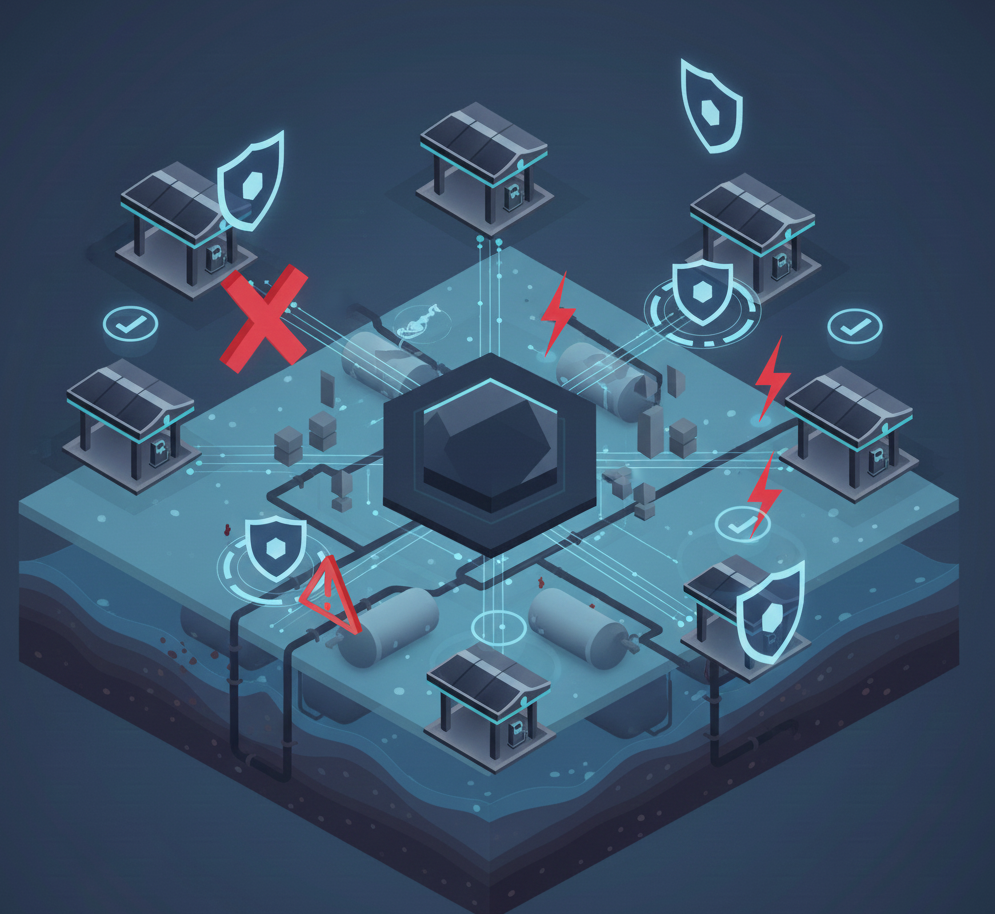
At enterprise scale, SIRA is no longer about reconciling fuel volumes. It is about proving that underground petroleum storage systems are continuously monitored, statistically validated, and escalated under governed thresholds — across every tank, at every site, every month.
Without system-of-record architecture, SIRA reporting fails silently until it fails catastrophically.
This article explains:
- How SIR/SIRA works structurally
- Why SIRA reporting collapses at multi-site scale
- The regulatory and enforcement implications
- The operational risk exposure created by fragmented reporting
- Why SIRA must be governed as compliance infrastructure, not administrative reporting
What Is SIRA? Structural Explanation for Enterprise Context
Definition: Statistical Inventory Reconciliation (SIR)
Statistical Inventory Reconciliation (SIR) is a leak detection method that uses statistical analysis of inventory, delivery, and dispensing data to determine whether an underground storage tank (UST) is leaking.
The U.S. EPA classifies SIR as an approved release detection method under federal UST regulations, with defined performance thresholds including:
- Probability of Detection (P(d))
- Probability of False Alarm (P(fa))
In Australian petroleum environments, SIRA is commonly deployed to meet leak detection requirements under:
- Protection of the Environment Operations (Underground Petroleum Storage Systems) Regulation 2019 (NSW)
- Protection of the Environment Operations Act 1997 (NSW)
- AS 4897 — Design, installation and operation of underground petroleum storage systems
How SIR Works — Structurally
SIR uses statistical modelling to compare:
- Opening inventory levels
- Deliveries (inbound fuel volumes)
- Dispensed sales volumes
- Closing inventory levels
Over a defined period (typically monthly), statistical algorithms calculate:
- Estimated leak rate (gallons/hour or litres/hour)
- Standard deviation of measurement error
- Confidence limits
- Whether the result exceeds regulatory thresholds
Key technical terms:
- Minimum Detectable Leak Rate (MDL): The smallest leak size that can be statistically detected with acceptable probability.
- P(d) — Probability of Detection: Likelihood the method detects a leak of specified size.
- P(fa) — Probability of False Alarm: Likelihood the method incorrectly signals a leak when none exists.
If results exceed defined thresholds, the tank is classified as:
- Pass
- Fail
- Inconclusive
In regulated environments, inconclusive or failed results trigger:
- Investigation requirements
- Re-testing
- Site inspections
- Regulatory notification (depending on jurisdiction)
This is not a spreadsheet calculation. It is a statistical compliance control.

Why SIRA Reporting Fails at Multi-Site Enterprise Scale
1. Data Integrity Fragmentation
At 200–1,000+ sites, SIRA data sources include:
- Automatic Tank Gauges (ATGs)
- Point of Sale (POS) systems
- Delivery dockets
- Wet stock contractors
- Third-party SIR vendors
Without centralised governance:
- Data formats vary
- Manual uploads introduce error
- Site-level corrections are not traceable
- Late submissions break detection windows
In enterprise networks, 3–7% of sites typically submit incomplete data each month. That means statistical validity is already compromised before modelling begins.
2. Inconsistent Escalation Protocols
When a tank returns an inconclusive result:
- Does the site manager understand the implication?
- Is re-testing automatically triggered?
- Is compliance notified centrally?
- Is regulator reporting tracked?
In spreadsheet-driven environments, escalation is email-based, undocumented, and operationally inconsistent.
At scale, this creates a systemic blind spot.
3. Absence of Evidence Lifecycle Control
Regulators do not ask, “Did you run SIR?”
They ask:
- Show me the report.
- Show me the data inputs.
- Show me the escalation path.
- Show me corrective action records.
- Show me historical trend analysis.
Most networks can produce a PDF report.
Few can produce:
- Version history
- Time-stamped acknowledgment
- Evidence of action taken within defined windows
- Proof of continuous monthly compliance across all tanks
Without this, SIRA reporting becomes audit theatre.
Regulatory and Enforcement Exposure
Underground Petroleum Storage System Obligations
Under Australian frameworks such as the NSW UPSS Regulation 2019:
- Storage systems must have compliant leak detection systems.
- Loss detection procedures must be maintained.
- Records must be retained for defined periods (7 years in many cases).
Failure to demonstrate proper leak detection can trigger enforcement under the Protection of the Environment Operations Act 1997 , including:
- Clean-up notices
- Prevention notices
- Prosecution for pollution of waters
- Significant financial penalties
For enterprise networks, exposure is amplified because:
- A systemic failure pattern can demonstrate governance weakness
- Regulator perception shifts from site-level failure to corporate negligence
Operational Risk Implications
Environmental Exposure
Delayed detection increases:
- Soil contamination
- Groundwater impact
- Remediation costs
- Civil liability
The financial delta between detecting a leak at 0.1 L/hour versus 0.5 L/hour over months is exponential.
Insurance and Financial Risk
Inconsistent SIRA governance:
- Weakens insurance defensibility
- Increases remediation provisioning
- Impacts asset valuation
Executive Risk
For Compliance Directors and Operations Executives:
- Incomplete SIRA records undermine board assurance
- ESG disclosures become unreliable
- Audit committees escalate oversight
SIRA reporting becomes a governance signal — not just a compliance requirement.

The Infrastructure-Based Governance Model
To function at enterprise scale, SIRA reporting must be governed as a Compliance Control Architecture.
This requires:
1. Centralised Obligation Modelling
Each tank must be mapped to:
- Jurisdiction
- Regulatory requirement
- Required detection method
- Escalation thresholds
- Reporting timelines
This creates a governed obligation register — not just monthly reports.
2. Automated Data Ingestion
Integration with:
- ATGs
- Wet stock reconciliation systems
- POS
- FuelSync (wet stock intelligence layer)
Reduces manual error and preserves audit traceability.
3. Exception-Driven Escalation
When thresholds are breached:
- Automatic task creation
- Defined escalation chains
- Time-bound remediation tracking
- Communication logged permanently
4. Evidence Permanence
Every monthly SIRA cycle must generate:
- Immutable report record
- Input dataset reference
- Timestamped sign-off
- Escalation history
- Regulator communication (if applicable)
This is system-of-record architecture.
Why Spreadsheets and Email Collapse at 500+ Sites
Spreadsheets fail at scale because they cannot:
- Enforce submission windows
- Prevent retroactive data edits
- Link reports to corrective actions
- Provide executive dashboards
- Maintain regulator-ready archives
Email fails because:
- Escalation threads fragment
- No single source of truth exists
- Responsibility becomes ambiguous
At 50 sites, this may be manageable.
At 500 sites, it is governance exposure.
Board-Level Framing: SIRA as Risk Infrastructure
For executive audiences, the question becomes:
Is SIRA reporting:
A) A monthly reconciliation task?
B) A distributed environmental risk detection system?
Only the second framing reflects enterprise reality.
SIRA reporting for enterprise fuel retail networks is:
- A statutory control
- A leak detection mechanism
- A liability mitigation system
- An evidentiary defence framework
Without infrastructure, SIRA becomes reactive compliance.
With infrastructure, it becomes continuous risk intelligence.
From Statistical Report to Compliance System of Record
SIR/SIRA is mathematically rigorous.
But mathematics alone does not create compliance.
At enterprise scale, SIRA reporting must be:
- Governed centrally
- Integrated operationally
- Escalated systematically
- Preserved evidentially
When treated as infrastructure, SIRA becomes:
- Continuous audit readiness
- Reduced environmental exposure
- Defensible regulatory posture
- Executive-level risk visibility
When treated as administration, it becomes latent risk.