


For decades, the backbone of service station compliance has been the checklist. Whether stored in a site binder or managed through company-wide spreadsheets, checklists have guided daily, weekly, and monthly compliance activities across fuel networks.
However, in today’s highly regulated and increasingly litigious environment, this legacy approach represents a critical and often misunderstood liability.
The evolution underway in fuel retail compliance is not simply a shift from paper to digital. It is a fundamental change in thinking — from checklists as reminders to platforms that function as systems of record. This shift is about building legal defensibility, operational consistency, and regulator trust at enterprise scale.
The Checklist: A Legacy of Ambiguity and Risk
Checklist-based compliance systems, whether paper or digital, are inherently fragile. They are designed to prompt actions but fail to create permanent, verifiable records of those actions.
This exposes enterprise fuel operators to three core risks.
Unverifiable actions
A checkmark represents an assertion, not evidence. During audits or post-incident investigations, signed checklists cannot prove tasks were performed correctly or that conditions were compliant at the time of inspection.
Perishable compliance history
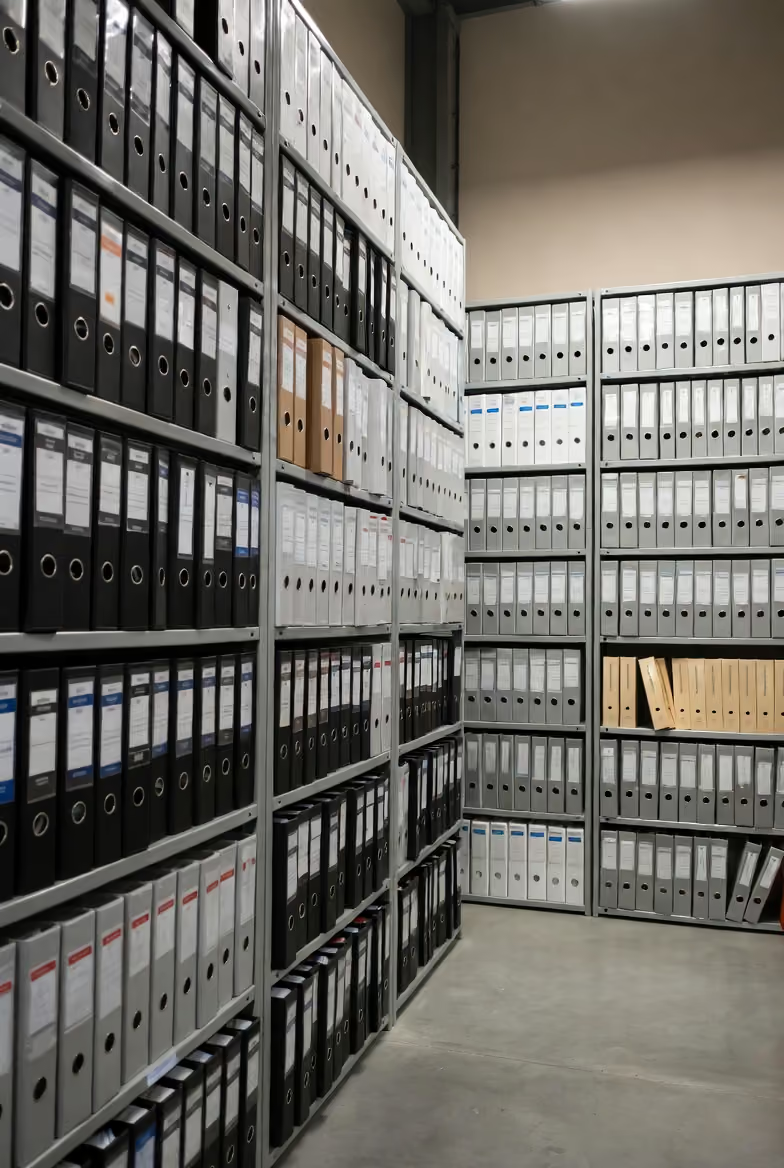
Paper records and spreadsheets are poor custodians of long-term compliance history. Manager turnover, missing binders, corrupted files, and inconsistent storage make it difficult — and sometimes impossible — to produce historical records when regulators demand them.
Inconsistent execution across networks
Checklist items are open to interpretation. The same task can be executed differently across sites, creating systemic inconsistency. Regulators expect uniform, repeatable processes for managing known risks — something checklist systems fundamentally cannot enforce at scale.

The System of Record: Turning Compliance Into Evidence
A system of record transforms compliance from task tracking into a permanent, evidence-backed ledger.
Instead of relying on declarations, systems of record require objective proof:
- Time-stamped and user-attributed records
- Photographic or data-based evidence
- Centralised storage with immutable audit trails
For example, a spill kit inspection is no longer a ticked box. It becomes a geo-tagged photo captured at a specific time, linked to a named user, and stored permanently. This creates indisputable proof that the task was completed correctly at that moment.
Crucially, systems of record preserve compliance history. When regulators request records from years prior — such as fuel reconciliation, leak detection, or maintenance logs — the organisation can produce complete, unbroken evidence chains instantly. This demonstrates due diligence and transparency rather than reconstruction or guesswork.
Consistency, Trust, and Enterprise-Scale Governance
Beyond evidence, systems of record enforce consistency.
Tasks that were once vaguely defined become structured digital workflows. Inspections follow the same steps across every site. Evidence requirements are standardised. Variability caused by individual interpretation is eliminated.
This systemic consistency is visible to regulators. When authorities see uniform processes applied across hundreds of locations — with evidence to support them — it builds trust. That trust often translates into more constructive regulatory engagement, reduced enforcement severity, and greater confidence in the operator’s governance framework.
At enterprise scale, compliance is no longer about individual site performance. It is about proving that the organisation has control over its risks everywhere, all the time.
The shift from checklists to systems of record is not about digitisation for its own sake. It is about replacing fragile reminders with defensible proof.
A checklist asks, “Did someone remember to do this?”
A system of record answers, “Here is exactly how, when, and where it was done.”
For enterprise fuel and convenience retail networks, this distinction is critical. Platforms like Vertex Pulse provide the system-of-record foundation required to protect the business, demonstrate due diligence, and transform compliance from a scattered liability into a controlled, enterprise-grade asset.